How to become an Adirondack 46er
Climb all 46 High Peaks, then register online with the Adirondack 46ers. Here's how the list came to be, what registering involves and the rules you'll meet on the way
To become an Adirondack 46er, you climb to the summit of all 46 Adirondack High Peaks and back down, then fill out the finisher form on the Adirondack 46ers website and pay a $20 application fee (2026). The club emails you a 46er number, and you receive a certificate the following spring. There's no time limit, the peaks can be climbed in any order and in any season, and the form is online only.
The rest is the hiking, which is a big project. Some peaks are short half-day climbs from Route 73, others are 15-mile days to summits with no marked trail. Here's how the list works, how registering works and what the state asks of you in the High Peaks Wilderness.
- Peaks46
- HighestMount Marcy, 5,344 ft
- LowestCouchsachraga, 3,820 ft
- Finisher fee$20 (2026)
- FormOnline only
- Winter roundDec 21 – Mar 21
- Aspiring dues$15 a year (2026)
What are the 46 High Peaks?
They're the Adirondack mountains that were believed to be 4,000 feet or higher when the list was made in the 1920s. The list starts with two brothers, Robert and George Marshall, and their guide Herbert Clark, who climbed Whiteface Mountain on August 1, 1918, as their first High Peak. Bob Marshall's 1922 booklet The High Peaks of the Adirondacks described their climbs of 42 of them, and on June 10, 1925, the three finished all 46 on Mount Emmons. Clark is 46er #1, George #2 and Bob #3, numbers assigned after the club formed in 1948.
The club bases its list on the elevations in Russell Carson's 1927 book Peaks and People of the Adirondacks. Later surveys put four of the peaks under 4,000 feet: Blake Peak and Cliff Mountain at 3,960, Nye Mountain at 3,895 and Couchsachraga Peak at 3,820. They're still on the list, and you still have to climb them. Going the other way, MacNaughton Mountain now measures 4,000 feet, but the club says 46ers don't need to climb it.
One more peak changed in a different way. East Dix became Grace Peak in 2014, named for Grace Hudowalski, 46er #9, the first woman to finish the 46 and the club's historian for decades.
How do you register as a 46er?
Register online at adk46er.org once you've climbed and descended all 46. The club stopped accepting paper and emailed forms at the end of 2021. The steps:
- Create a website account on adk46er.org and verify your email address. You only need one, and it's one account per email address.
- Log in and open the finisher form (the "Regular Three Seasons" peaks registration, or the winter form if you finished in winter). Fill in every required section, including your climb dates.
- Pay the $20 application fee. Each finisher registers and pays separately, though you can register peaks on someone else's behalf from your own account.
- Watch your email. You'll get an official letter of congratulations with your climbing number.
Each year's class closes at midnight on December 31, and the club says registering promptly gets you a lower number. The new class roster usually goes up on the website in late March or early April. Certificates are handed out at the Spring Gathering on Memorial Day weekend in the High Peaks and mailed afterward to anyone who can't come.
Finished years ago and never registered? It's not too late. The club doesn't backdate numbers, so you'll join the current year's class.
How much does it cost to become a 46er?
The finisher application fee is $20 per person (2026). The club also has an Aspiring/Contributing membership for anyone still working on the list, at $15 a year (2026), which brings two issues of Adirondack PEEKS magazine and three newsletters a year. Patches, decals and other emblem items are for registered finishers only.
Parking is the other cost. At the Adirondak Loj, the most-used High Peaks trailhead, the Adirondack Mountain Club charged non-members $25 a day in 2026, or $15 after 1 p.m.
What is the 46er correspondent program?
It's an optional way to share your progress with an experienced 46er while you work on the list. You sign up at talk.adk46er.org, log your hikes and photos, and an assigned correspondent writes back. The club says it has close to 100 volunteer correspondents.
Correspondence used to be required. Starting in 1937, Grace Hudowalski kept a folder for every aspiring 46er and wrote to each one personally, a tradition that ran for decades. By spring 2013 there were too many hikers for the historian's office to keep up, and the club dropped the requirement. The online version opened in summer 2015.
How long does it take to finish the 46?
As long as you like. There's no deadline, and the club says it doesn't collect or publicize records for speed, age or number of rounds. Its first members took years: the Marshalls and Clark finished seven years after Whiteface, and Grace Hudowalski climbed Marcy in 1922 and finished on Esther Mountain in 1937.
What sets the pace is distance. Many of the High Peaks are deep in the wilderness, so a lot of hikers group neighbors into one long day or an overnight. Mount Marcy alone is 14.8 miles round trip on its standard route; our guide to hiking Mount Marcy breaks that day down.
Which High Peaks have no marked trail?
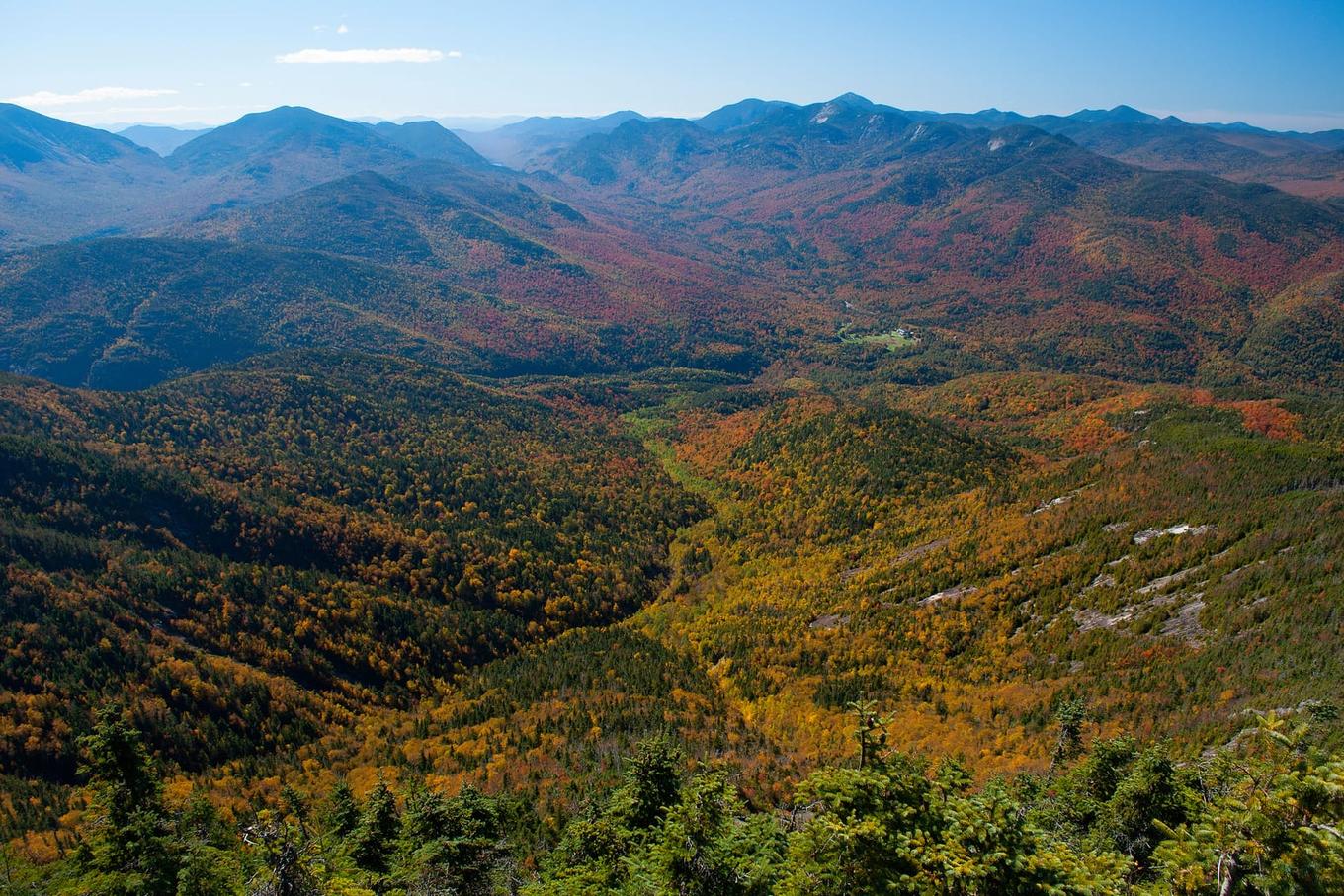
The DEC's 2018 management plan for the High Peaks counts "21 traditional trailless peaks," summits with no DEC-marked trail to the top. They include Allen Mountain, Mount Marshall, the Seward and Santanoni ranges, Street Mountain and Nye. The DEC's 1999 plan for the High Peaks Wilderness counted 16 trailless peaks of 4,000 feet or more in that unit alone, before the Dix Range was added to it.
The name is a bit misleading. Most of these summits have worn footpaths, called herd paths, and a 2026 visitor use report for the DEC says they've become easier to follow as use has grown. The state still doesn't formally maintain them, and the DEC warns that many herd paths on Mount Marshall and other trailless peaks wander around the slopes without reaching the top. Its advice is to navigate with a map and compass instead of following paths other people made.
The 46ers once kept canisters with sign-in registers on the trailless summits to record ascents, starting on Emmons in 1950. Most were replaced with wooden signs in 2001 under the state's management plan.
Where do most people start?
Usually at the Adirondak Loj or the Cascade Mountain trailhead on Route 73. Cascade Mountain and Porter Mountain are among the shortest routes to any of the 46, and many people climb both in one hike.
Parking at Cascade is the catch. The trailhead lot on Route 73 is small, and the DEC says it's enforcing the No Parking Zones along the highway. A new trail to Cascade from the Mount Van Hoevenberg Olympic Sports Complex, with its own parking, is under construction and isn't open yet.
The Loj, at the end of Adirondack Loj Road outside Lake Placid, is the start for Marcy, Algonquin Peak and several others. ADK doesn't take reservations there, its lots often fill before 6 a.m. on summer weekends, and it doesn't let cars wait for a space.
Two more things to plan around. Trailheads that cross the Adirondack Mountain Reserve in St. Huberts, the main start for Blake, Colvin, Dial, Nippletop and Sawteeth and one way up Gothics, need a free parking reservation from May 1 to October 31. And an April 2026 report for the DEC recommended daily visitor caps of about 400 for the Adirondack Loj Road trailheads and 240 for Cascade. The DEC hasn't adopted them and was still reviewing public feedback in November 2026, so check before a 2027 trip.
What are the rules in the High Peaks Wilderness?
Most of the 46 are in the DEC's High Peaks Wilderness, which has its own rules on top of the usual state land regulations:
- Group size. At most 15 people on a day hike and 8 overnight. Permits for larger groups aren't available.
- Bear canisters. Required for every overnight camper in the Eastern Zone, which holds most of the highest peaks, from April 1 to November 30.
- No campfires in the Eastern Zone.
- Camping. None on summits or above 3,500 feet, except at a lean-to.
- Dogs must be leashed throughout the Eastern Zone, and at trailheads, campsites and above 4,000 feet everywhere else.
- Snowshoes or skis are required once snow is at least 8 inches deep.
What is a Winter 46er?
A Winter 46er has climbed all 46 between December 21 and March 21, inclusive. Edgar Bean finished the first winter round on Blake Peak in 1962, and the club has recognized winter finishers since 1990. You register on the winter form, also for $20 (2026), and a "W" goes after your climbing number.
If you're already a 46er, log in to your existing account before registering your winter round, or the system will think you're a new climber and give you a second number. Winter climbs also count toward a regular round, and you can become a 46er with a winter round alone. The club is blunt that the winter round is only for hikers in excellent shape, well equipped and skilled in winter travel, and it suggests hiking with experienced winter hikers.
Keeping track of the 46
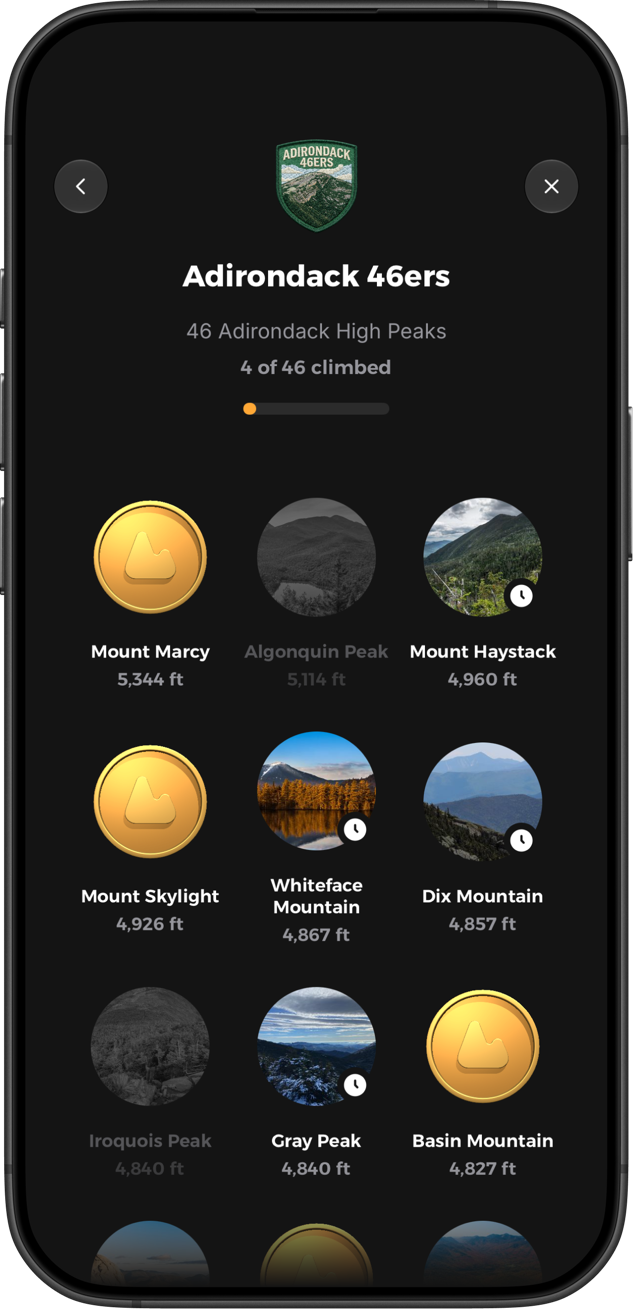
Yak is a free app for iPhone and Android, and its Adirondack 46ers quest shows every High Peak, which you've climbed and which are left. Log each one with the date, notes, photos and conditions, so your climb dates are in one place when it's time for the finisher form, and check the 5-day forecast for the trailhead, mid-mountain and summit before you go. Our roundup of 46er apps compares Yak with the other trackers.
Fees and rules here are for 2026 and can change, so check the 46ers and DEC pages before you go.